
Case Study: Proving the Case for a Digital Production Tracker
TDS is a global software consultancy operating across Europe and North America, with offices in Newcastle, Edinburgh, Warsaw, Wrocław and Calgary.
We work with clients across the globe to provide clients with a team of consultants to give their project a final push or a full scrum team to help scope and deliver your project from start to finish.
Our team at TDS supported a client operating in the engineering industry to replace a failing Excel-based Bill of Materials (BOM) with an evidence-led, technically proven case for a purpose-built digital platform – de-risking the investment before a single line of production code was written.
The TDS Approach
Our client knew their production process was straining but had no objective picture of where the cost sat or what a solution would prioritise.
TDS was engaged to replace assumption with evidence by quantifying the real problem, prove a solution was technically feasible and define a costed, ready-built plan. This engagement de-risked the decision to invest before any investment was ever committed.
We discovered that 20 hours a week were lost to manual error-checking and data correction alone, turning an invisible, tolerated cost into a hard number that made the case for change impossible to ignore.
From our initial discovery, we had a clear understanding of the issue causing operation inefficiencies, and were able to highlight clearly to Senior Leaders where digitisation could support their wider production operations.
Situation: Where Did The Client Start?
Production tracking rested on a single Excel Bill of Materials that had quietly outgrown its purpose. The system was now carrying the entire production process on a tool never designed to bear it.
This looked like:
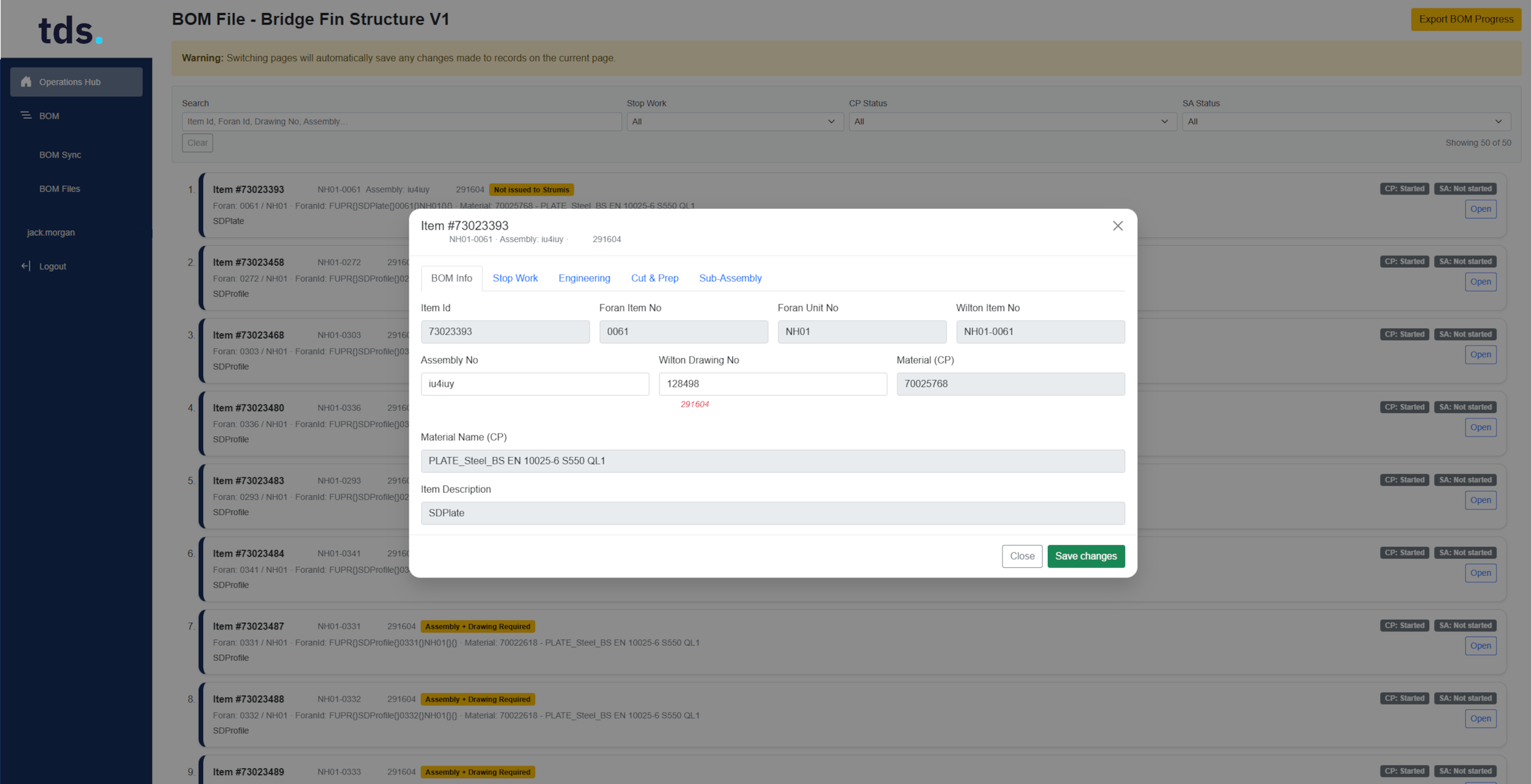
- A spreadsheet at breaking point: with 103 columns and over 2,700 rows doubling as data store, job card, progress tracker and report, the spreadsheet crashed frequently.
- No governance: any user could alter or delete live production with no audit trail, and no way to recover the previous state.
- Islands of data: production progress lived in isolation from finance and accounting solutions, forcing duplicate manual entry across systems.
- Rework on every revision: a revised Bill of Materials arriving from the end client triggered hours of manual reconciliation.
The people running this process were working hard, but they were working hard to compensate for the gaps their tools left behind. Our client knew things could be better; what they lacked was an objective, quantified picture of where the time was going and what a fix should prioritise.
That’s when TDS stepped in.
Task: What Needed To Be Proven?
TDS’ team of expert consultants was asked to answer three questions with rigour and evidence, rather than assumption. Above all, these questions would be answered to help de-risk the decision to invest before any budget was committed to a full build.
The questions we answered were:
- What is the real cost? The quantifiable operational problems in our client’s production process needed to be measured through observation and data, not estimated.
- Is it feasible? We needed to confirm whether a modern, integrated digital platform could work in their environment, and whether that could be proven before investment.
- What should the MVP be? If feasible, what the first production-ready build should contain, how long it would take, and what it would cost.
We needed to help the client see what good looked like before committing to it. They needed to trust the numbers and see the solution working before signing off a full build programme, so every workstream was designed to reduce risk and increase certainty ahead of the investment decision.
Action: What Did TDS Do?
A multi-disciplinary team from TDS ran two structured workstreams – the first to understand the business deeply and measure the pain, the second to prove the technology with a working proof-of-concept.
The two workstreams covered:
- Discovery, at workflow level: structured interviews across six business functions, facilitated workshops, direct observations and time-and-motion studies on shop-floor supervision.
- Objective prioritisation: the RICE framework (Reach, Impact, Confidence, Effort) ranked improvement opportunities by evidence, not opinion.
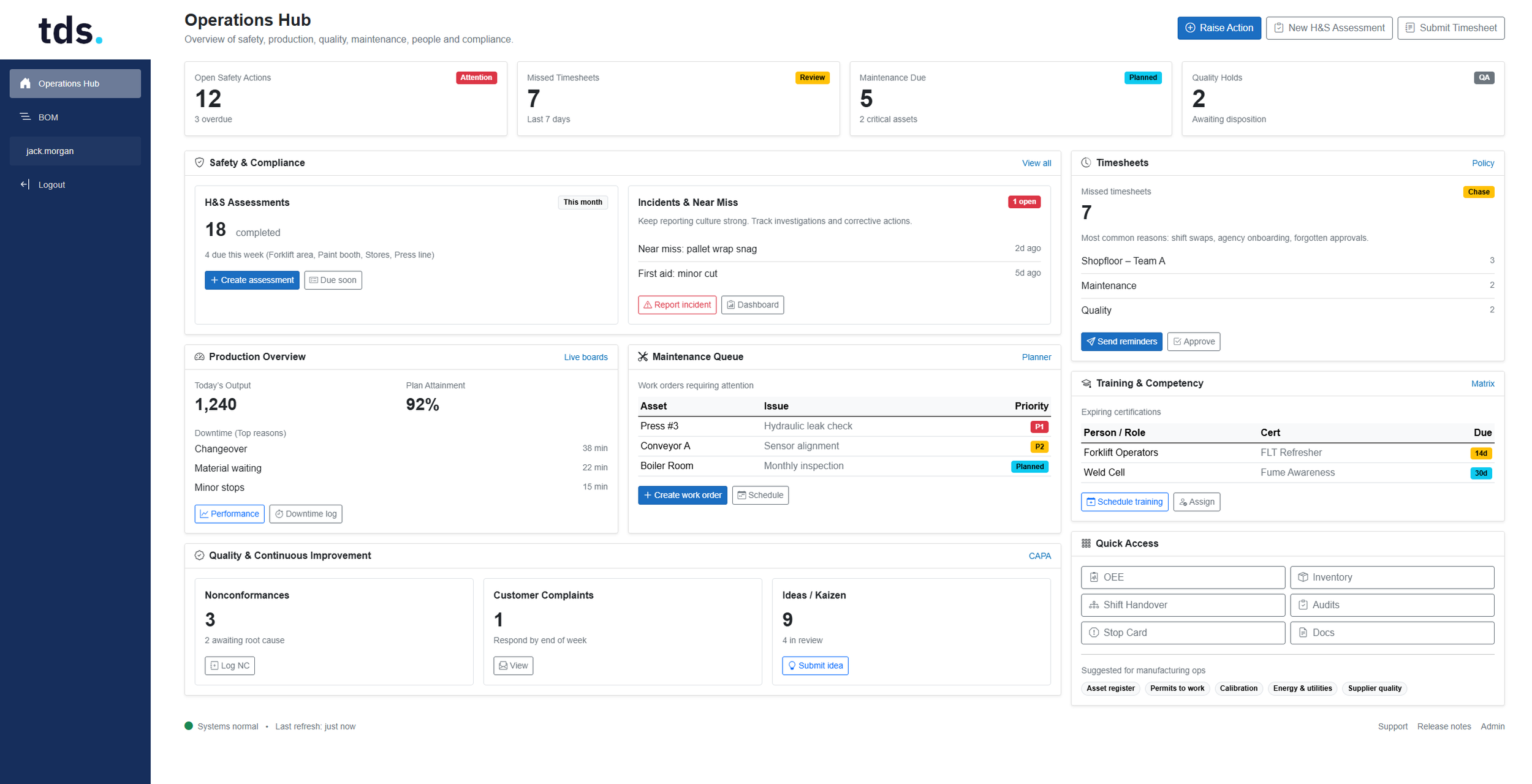
- A working proof-of-concept (PoC): a governed BOM application on Azure with Entra ID role-based access, finance software API integration and a pre-defined section of the workflow digitised against real data.
- From PoC to a costed MVP: a requirements workshop set the must-have scope, producing a prioritised a feature-led backlog across a phased delivery plan.
The PoC was deliberately scoped as a validation exercise to prove feasibility and benefit delivered before any large-scale commitment. Throughout this process, TDS held to honest framing: this was discovery and proof-of-concept, never overstated as a completed implementation.
During the discovery process, we measured the true cost of the client’s production process. Every figure was drawn directly from our evidence-based discovery across six business functions:
- 20 hours a week were lost to manual error-checking and data-entry correction alone, before counting rework or disruption.
- 7 hours of rework were needed every time a revised Bill of Materials arrived from the end client.
- 68 times in one week did a supervisor leave the shop floor for admin.
- 120 hours were spent on document conversion in a single three-week project window.
- 30% of timesheets were changed after submission, against a BOM with over 2,700 rows that crashed under its own weight.
These hard numbers landed because they turned a tolerated, invisible drag on the business into a clear, quantified case for change. This gave our client the confidence to invest in a solution it had already seen proven.
Result: What Did TDS Deliver?
TDS delivered a prioritised feature-led build scoped across four phases – a decision-ready path from proof-of-concept to production.
Our work led our client to move from an undocumented, instinct-led understanding of its own operations to a fully evidenced, technically validated and costed case for a purpose-built Production Tracker. As a result of this project, our client gained:
- Evidence base – an objective, RICE-prioritised picture of where time and money were being lost.
- Proven architecture – Azure, Entra ID and existing operational software were validated against real production data.
- Costed MVP – a feature-rich backlog against four phases and a structured week plan.
- A foundation for more – a modular design extending to time recording, HSE and integration.
- A de-risked decision – value was proven before our client committed to the build.
TDS can support your next project
At TDS, we work with businesses in both the public and private sectors, across industries such as banking, healthcare and utilities.
Our trusted consultants are dedicated to helping you fill your skills gap, ensure your team meet strict deadlines, upskill your own staff and build lasting, working relationships.
Contact us to see how we can help upshift your operations to the next level.