
Embedding AI Across the Delivery Lifecycle for a Prime Brokerage

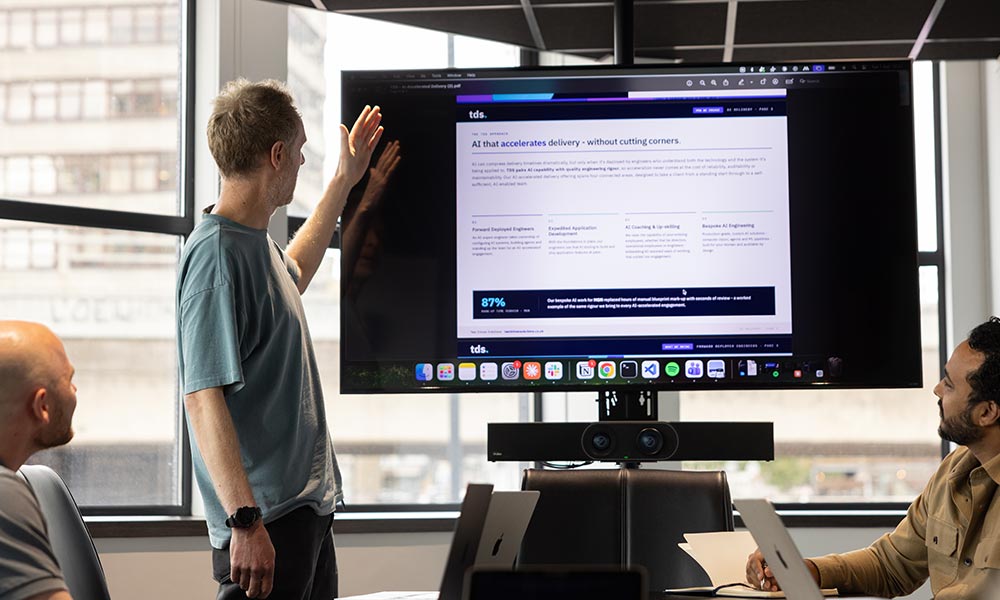


TDS provides technical leadership and embedded engineering expertise to a leading capital markets organization. The team develops critical frontend interfaces and operational workflows used by investment professionals to view and manage live market positions where real-time accuracy and performance are essential.
Over the past year, TDS led a comprehensive initiative to embed artificial intelligence across the software development lifecycle: spanning code review, active development, agile planning, and end-user product capabilities. Working alongside internal engineering teams, TDS established governance frameworks, custom tooling, and training programs to ensure scalable adoption.
The Challenge
Operating within a high-velocity engineering culture characterized by continuous deployment and frequent incremental releases, the client sought to maximize productivity using AI assistance. However, operating in a highly regulated financial environment required strict governance, ensuring quality standards remained uncompromised and sensitive data remained secure.
Key operational challenges included aligning AI-generated outputs with organizational coding standards, maintaining robust data privacy controls within approved enterprise tooling, and establishing consistent AI practices across hybrid teams of internal staff and external consultants.
Solution and Implementation
Strategic approach
TDS introduced a progressive implementation framework, deploying AI capabilities incrementally based on risk profiles and team trust. All workflows strictly adhered to enterprise security policies, utilizing approved AI tooling with full human oversight and accountability for all production deployments.
The rollout proceeded across five key phases:
- Standards & Governance Definition: TDS established a comprehensive engineering playbook to guide AI interactions, codifying architecture rules, performance metrics, security principles, testing standards, and verification checklists.
- Automated Quality Control: AI tooling was integrated into the peer review workflow to perform initial code checks against defined playbooks and verify test coverage before human validation.
- AI-Assisted Development: AI pair-programming practices were embedded into daily engineering activities to assist with code generation, structural refactoring, bug investigation, and impact analysis across shared codebases.
- Upstream Planning & Design Integration: AI capabilities were extended to requirement specification, translating high-level concepts into detailed technical tasks and generating early UI/UX mockups for rapid validation.
- Product-Level AI Features: Intelligent natural-language interfaces were introduced into customer-facing applications, enabling users to dynamically configure workflows, views, and data analytics.
Key Deliverables
- A standardized engineering playbook and AI prompt framework tailored to organisational standards
- Automated review tooling to evaluate code quality, compliance, and test coverage prior to deployment
- Comprehensive team enablement and training programs on secure, high-efficiency AI engineering practices
- Integrated workflows for AI-assisted development, refactoring, and system impact analysis
- AI-enhanced planning pipelines for task specification and rapid visual prototyping
- Production-ready natural language features facilitating dynamic user dashboard and workflow configuration
- A robust operating model guaranteeing strict enterprise governance and data privacy compliance
Results and Outcomes
- Increased Quality and Test Reliability: Standardized AI test generation significantly expanded automated test coverage and release confidence.
- Optimized Review Cycles & Lower Defect Rates: Combining automated AI analysis with single-human sign-off streamlined code review velocity while simultaneously reducing production defects.
- Enhanced Team Productivity: Clear automated guidance enabled engineers across varying domain expertise levels to contribute effectively to complex areas of the codebase.
- Accelerated Delivery Timelines: Upstream AI planning and early visual prototyping aligned stakeholder expectations earlier in the development lifecycle, minimizing rework.
- Enterprise-Grade AI Governance: Demonstrated that AI-driven delivery acceleration can be achieved within highly regulated environments without compromising security or compliance.
- Scalable Framework: Established reusable organizational playbooks and enablement patterns suitable for broader deployment across enterprise software teams.
